Skerzi fid-dinja annimaleska

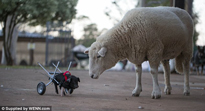
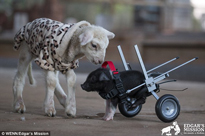
altSkerz, nofs kelb u nofs qażquż, li twieldet b’numru ta’ fatturi ħżiena għal saħħitha, sabet kenn f’dar f’Alabama.
 
Sidtha, Kim Dillenbeck adottat lil din l-annimal li ngħatat l-isem ta’ Pig waqt vjaġġ li għamlet f’Atlanta biex iżżur lil oħtha.
 
Tirrakkonta li fi żmien il-Milied, marret ma’ oħtha għand xi ħbieb biex jieħdu kolazzjon u xi ħadd semma l-istorja ta’ Pig. Ilkoll marru fid-dar ta’ din l-persuna biex jarawha. 
 
altAppena ratha, u ntqalilha bil-problemi ta’ saħħa li kellha, Kim iddeċidiet li trabbiha sakemm tmut. Kulħadd ħaseb li ma kellhiex ħajja twila minħabba li l-organi tagħha kienu b’mod li setgħet tifga.
 
Pig, li twieldet fis-selvaġġ, ittieħdet ma’ ħutha, minn mara li semgħethom jinbħu. Meta ħadet lil Pig għand veterinarju, qalilha li għandha kustilji neqsin, ġogi mdawrin ħażin u x-xewka ta’ daharha mhix kif għandu jkun.
 
Minkejja l-qies tagħha, li hu ta’ nofs kelb, Pig, li għandha tmien xhur, tista’ tikber aktar. Sidtha l-ġdida tinsab f’dilemma: bejn tixtieqha tikber ftit ieħor, iżda fl-istess ħin tibża’ li jekk tikber, tasal biex tmut.
 

Adam, Eve and the Apple

It is an accepted fact to all Christian faiths that Adam and Eve were the first man and woman created by God. According to Luke “God created Adam from dust, and then breathed life into him”. Then, in the first-ever ‘surgery’, God removed a rib from Adam’s side and from it he created Eve. When God pronounced judgements for their disobedience, he told the serpent that he would crawl on his belly and eat dust; he told Eve that she and all women after her would have pain in childbirth; and he told Adam that he and all his descendants would experience painful toil on earth until death. When bad Cain murdered good Abel, our fore-parents had another son, Seth, from whom, it must be, we are descended.  

And what about the apple? Was it really an apple? There are different interpretations of this incident that happened at the Garden of Eden. Some say that the word ‘apple’ is symbolic; it means God forbade our fore-parents to do something, but not exactly not to eat an apple. Others say that it was the ‘Tree of the Knowledge of Good and Evil’ that was forbidden, and others hold that it was truly an apple fruit. I sometimes wonder what today’s picture would be if our fore-parents had not disobeyed God’s wishes. The idyllic life of no labour, no disease and no death, would have meant that today there is no need for work, for hospitals, for cemeteries, for doctors and for undertakers. It would also mean that men and women, thousands of years old, would be roaming the streets of town! I don’t know what to think really. 

But all that was in the very remote past. Today, as it happened, Adam and Eve were drifting smoothly on cloud 9. They had, so many thousands of years ago, by hook or by crook, made it to the Heavenly Gates and into Paradise, but only just. As they looked down on the world below them, they saw 7 billion people on planet Earth spread out over the five continents. All these people were family members but so different in appearance, language, religion, ideologies, culture, skin colour and way of life.  

They noticed how things have progressed since their early and primitive time – skyscrapers in every city, nuclear energy, medical advances, sending rockets to the stars, computers, fashion, entertainment and so many other things besides. But they also saw that the people were in a race to dominate each other and were often intent on hating and hurting each other – wars, killings, burglaries, injustices, accidents and other catastrophes. These self-inflicting sufferings have been repeating themselves so many times over and over again. They never learn. 

Eve elbowed Adam as she pointed downwards. “But there are some very good men and women around. Look at that humble man from Argentina preaching love, peace and brotherhood to everybody; and several others who, unknown and behind the scenes, work tirelessly to help those in need of assistance – the poor; the sick; the elderly, children, those living in war-shattered zones. These are only a few, I know, but they are so good people who need and deserve our support.”  “Yes. It’s a pity that the good ones are only a few”, replied Adam, “What can they do against all those others, intent on making their own world such a bad place to live in?”

Suddenly Adam, still handsome despite the years, turned towards Eve and said to her, “Why did you do it Eve?”  “Do what?” she replied taken aback by his sudden question. “Give me the apple, in the Garden of Eden, remember?” he retorted. “Oh, that”, exclaimed his wife. “It was the ugly serpent. He tempted me and I believed him”. “You know something Eve?” said again Adam, “I didn’t even like it. I have not eaten another one during all these years!” 

“And that damned apple has brought us and our descendants so many troubles and tribulations” said Adam. “Yes, Yes”, replied Eve, “As a result of our folly we and all the members of our family, had to toil for our living, we contacted all kinds of diseases and we had to die”. “Imagine if we had not eaten that apple, what a wonderful life we would have had Eve” said the first man on earth. 

But there is one thing that puzzles me” retorted Adam again. “What?” asked Eve. “Its’ that today, so many thousands of years after we had eaten that apple, the learned doctors on earth tell their patients that ‘an apple a day keeps the doctor away!”  

Elizabeth Fry (1780–1845)

Charles B. Spiteri

BDL Books - Nisa Magħrufa

Elizabeth Fry kienet mara mhux tas-soltu. Ħafna nies kienu jaraw kif jevitaw il-ħabs iżda hi daħlet fih biex tara b’għajnejha l-ħajja li kienu qed iqattgħu hemm in-nisa u t-tfal. Tant indiehxet b’li rat li qatgħetha tagħmel xi ħaġa biex tbiddel il-qagħda.

Elizabeth twieldet f’Norfolk u l-membri tal-familja tagħha kienu Quakers. Kien fl-1813 li semgħet dwar il-kundizzjonijiet fil-ħabs ta’ Newgate, u ma’ grupp ieħor ta’ Quakers marret iżżur l-agħar ħabs fl-Ingilterra.

Nisa u tfal inġemgħu madwar Elizabeth. Hi osservat kif kienu jilagħbu, jixorbu u jisirqu lil xulxin il-priġunieri, għax ma kellhomx ħaġa oħra x’jagħmlu. Elizabeth marret kemm-il darba b’mod regulari żżur il-ħabs ta’ Newgate.

F’ċella vojta, introduċiet skola għat-tfal u lin-nisa ħaditilhom xogħol ta’ ħjata, li għalih kienet tħallashom. Aktar tard, Elizabeth introduċiet għaqda ta’ għajnuna lill-ħabsin u ppruvat tipperswadi lill-Parlament jibdel il-ħabsijiet. L-awtoritajiet semgħu minnha. Emmnu li l-metodi tagħha ħadmu. U l-ħabsijiet fl-Ewropa, kif ukoll fl-Ingilterra, bdew jinbidlu għall-aħjar.

Il-Quakers huma grupp Kristjan li jemnu immens fil-paċi u fl-għajnuna lil nies oħra. Anki meta kienet ċkejkna, Elizabeth kienet iżżur nies morda u tgħallem kemm tista’ lit-tfal foqra.

Fl-1780, is-sena li fiha twieldet Elizabeth, fil-Ħabs ta’ Newgate kien hemm rewwixta. L-għamara u l-bini ngħataw in-nar u 300 priġunier inħelsu.

The Librarian

Helen and Margaret were sisters but they were as different as chalk and cheese. Helen was outgoing, extrovert, friendly, confident, talkative, noisy, exuberant and always laughing. She was also beautiful with a fine delicate complexion, high cheekbones and long auburn hair that seemed to be always shining. Margaret, on the other hand, was introvert, timid, lonely, more of a listener than a talker and unsure of her place in the world. She was also rather common-looking with a pallid face, slightly protruding nose and mousy black hair which seemed always needing to be combed. 

And yet they were as inseparable as twins – always together, looking after each other, going out together. They had no secrets between them so much so that oftentimes they recounted their dreams and expectations of life. Very often they were in each other’s room, swooning over records of their favourite singers. Helen liked modern singers and bands like One Direction and Rihanna while Margaret favoured the old singers like Elvis Presley, Dean Martin and Johnny Ray. 

Margaret ran single-handedly the town’s library with dedication and fervour that put a smile on her face every day. She was passionate about books, reading everything that came her way, whether they were ‘classics’ or ‘comics’. She knew all there was to know about books and their authors. Clients told her that she was ‘a walking reference book’. She had purposely sought work at the library because she genuinely loved books. She felt calm and at ease in the quite atmosphere of the library surrounded by shelves and shelves of all kinds of books. 

In the evening, when her sister was out with her boyfriend, Margaret liked lounging in the small sitting room engrossed in a new publication while her father smoked his pipe or read the newspaper. The picture-frame on the mantelpiece showed a photo of her mother who had died five years ago. It was, in fact, her Dad who saw to their up-bringing, watching them emerge from teens to young women. And Margaret was Dad’s favourite. “You know Marge”, he told her as he put his newspaper down for a moment, “You may think that beautiful people have an advantage over the likes of you and me. But if Helen’s got beauty, you have brains. You’ll always have a good brain to rely on while beauty fades with age. Just remember that when you feel sometimes envious”. “I’m not envious Dad, but sometimes wish that life is more generous with me, that’s all” replied his daughter. “That’s why you must use the talents you’ve been given Marge, to get what you want from life” retorted her Dad. He patted her affectionately on the knee but he could see that she had more than her fair share of lemons and therefore could understand her attitude to life.

When Helen took up with Ben, she encouraged her sister to go out on dates with friends of her boyfriend. She did go out with a couple of boys but there was no follow-up interest and, therefore, she returned back to her old routine of library work and home by her father. One evening, while smoking his pipe, her Dad noticed that his young daughter was staring at the ceiling. “A penny for your thoughts Marge”, he said. “They aren’t worth a penny Dad”, she replied. “A half-penny then”, he again responded. “They aren’t even worth that much either”, said Margaret in a subdued tone, fed up and feeling miserable. “Some aspects of life are sad dear, but there is nothing we can do to change them”, said her father in an effort to cheer her up. 

One day at the library, she noticed a man looking for a book in the ‘classics’ section. It looked as if he had not found what he was looking for. She left her desk, went over to him and asked if he needed any help. “I’m looking for ‘The Black Arrow’ by Robert Louis Stevenson, but I can’t find it under the ‘S’ shelf”, he replied. She went to check the movement of books loaned out to clients in her computer and found that the book had been loaned out two weeks ago. “It’s out Mr, but it should probably be returned by next week, shall I hold it for you?” she asked. 

When he returned the following week, she gave him the book but they also started chatting about the ‘classics’, what books they liked, their favourite authors and other subjects. His name was Steve and he worked as an accountant. They found that they had a lot in common, especially books. He came frequently to the library and their conversations about books and about life in general continued. Margaret found that she liked him and looked forward to see him. He was decent, intelligent, book lover and, of course, good-looking men don’t come along very often. This could be her spark of happiness. She also hoped that he liked her, despite that she was not beautiful like her sister and that eventually he would invite her for coffee or something. With such small things does love begin, she thought. 

Their unscheduled meetings and literature gossip continued for some weeks. She still harboured hope of a romantic ending with Steve. One day, after discussing the merits of an author and his novels, he asked her – “Are you free next Saturday Margret?” She was stunned. Her heart beat faster than usual; the words she had hoped to hear had finally been said. This was the beginning of something special. “Yes, yes, I am”, she replied. “In that case, I want to invite you to my house for tea, would you accept Marge?” her new-found friend asked. ‘He is serious in his intentions’, she thought and immediately accepted his surprise invitation. She waited, in anticipation for his next words. Then he continued “I want you to meet my wife! She’d be pleased to meet you”.  

Sejba u aktar għarfien fuq il-Wari

altArkeologi fl-Amerika t’Isfel, dan l-aħħar sabu qabar mhux mimsus li jagħti dawl fuq iċ-ċivilizzazzjoni qadima u misterjuża tal-Wari. Dan wara li kixfu l-iġsma mummifikati  ta’ tliet irġejjen, qrib teżori tad-deheb u sagrifiċċji makabri umani.
 
It-tempju tal-mejtin, li għandu 1,200 sena, nstab fis-sit El Castillo de Huarmey, erba’ sigħat bogħod bil-karozza fin-naħa ta’ fuq tal-kapitali Peruvjana, Lima.
 
altDan il-qabar jagħti minjiera ta’ informazzjoni fuq l-imperu enigmatiku tal-Wari, li ħakmu ’l-Andes ħafna qabel is-suċċessuri magħrufin tagħhom, magħrufin bħala l-Incas.
 
Milosz Giersz, arkeologu ewlieni fit-tim Pollakk-Peruvjan qal li: “għall-ewwel darba fl-istorja tal-arkeoloġija fil-Peru’, sibna qabar imperjali, li jmur lura għall-imperu u l-kultura tal-Wari.”
 
altaltIr-riċerkaturi qalu li din is-sejba se tgħinhom jgħaqqdu flimkien it-tip ta’ ħajja fl-Andes, sekli qabel ma nħoloq l-imperu tal-Incas, li nkiteb ferm fuqhom mill-Ispanjoli li rebħulhom u ħadulhom l-artijiet.
 
Fil-mawsolew, f’piramida kostali, nstabu bċejjeċ tad-deheb, ċeramika u 63 skeletru ta’ madwar 1,300 sena ilu. Ir-riċerkaturi qalu li ħafna mill-iġsma misjuba fil-qabar, kienu ta’ nisa mummifikati bilqiegħda – ħaġa li tindika s-sinjurija u tixhed li n-nisa Wari kellhom aktar saħħa milli kien maħsub qabel. 
 
altL-arkeologa Patrycja Przadk qalet li n-nisa kienu midfunin b’imsielet ta’ metalli prezzjużi mnaqqxin, li hu mifhum li dari kienu jintlibsu biss mill-irġiel. Fost l-artefatti misjuba maġenb l-irġejjen mummifikati nstabu għodod tal-insiġ, magħmulin mid-deheb, skieken u mnanar ritwali, kikkri, kontenituri għall-weraq tal-coca,  u numru sabih ta’ kontenituri taċ-ċeramika mżejnin b’mod sabiħ.
 
L-istoriċi jemmnu li l-Wari, li ħakmu bejn is-sena 600 u l-1100 wara Kristu, kienu l-ewwel nies li rnexxielhom jgħaqqdu t-tribujiet diversi f’network wieħed sofistikat mad-dawra kollha ta’ dawk li llum huma l-Andes Peruvjani.
 
altIl-bioarkeologu Wieslaw Wieckowski qal li sitt skeltri ma kinux imlibbsin, u dan jixhed li ntużaw bħala sagrifiċċji umani għall-elit mummifikati.
 

The Future of Maltese Folksong

Għana has been used  to draw attention to issues varying from petty squabbles to religious-political situation which had evolved  at various times in Malta.

It has really never been the subject of serious discussion and analysis at an academic level. It is therefore refreshing to see this publication by Manuel Casha which invites us to have a new and unprejudiced  look  at what Għana really stands for. He himself states that he started to write this book ‘with the intention of understanding the techniques, ethics, traditions and customs  of this music and the community that engages in it, as an outsider looking in’, and he invites us to do likewise. It is not often that a book dedicated to Maltese folk singing (Għana) comes to hand, and for this we have to thank Manuel Casha who has strived hard for decades to ensure that this unique form of self-expression is not lost forever. As he says in his introduction, ‘the soul and psyche of a nation are often embodied in its folkloric past’.

This type of folk singing was limited to a certain aficionados, and was frowned upon by the educated elite. It is not surprising therefore that it was foreigners who published what is arguably the best collection of Maltese folksong (by Bertha Ilg and Hans Stumme in Germany) over a century ago.

It has been stated that singing preceeded speech in the development of human interaction. It is certainly likely that Għana was the first attempts at Maltese literature and versification. In this book Casha explains the background of this art form, and how it has filled a niche within the life-style of those who, while not usually over-educated, can yet express themselves so eloquently in song.

One good definition of Għana could well be: Working class men enjoying themselves in song. This emphasises the origin of the singing, highlighting the fact that it was originally invented by unschooled and illiterate but highly intelligent men who needed a poetic outlet to express their feelings and to entertain their friends. There is nothing  unique  about this development. All people around the world have the same needs to develop their own style of expressing them. The  author compares Maltese Għana as a musical form similar to Blues music in America, Flamenco in Spain, Rebitika in Greece or Fado in Portugal, all of which form part of a global musical heritage. He goes so far as to predict that ‘once Għana music is discovered universally, outside of the Maltese archipelago, it will contribute a great deal in telling the story of the contemporary development of Mediterranean music, as we know it today’.

With the massive wave of migration that took place in the immediate post-war period, many folksingers left Malta to settle in places like Australia and elsewhere. They  brought with them their guitars as well as their love of Għana, which they enjoyed to display, to entertain their friends, in their homes, or even garages, to remind themselves of the Malta they had left behind and still hankered for.   By the mid 20th century, thousands of Maltese emigrated to other countries in search of a better life, carrying with them their musical heritage in the countries of their settlement.

It is interesting to note how Għana in Australia might have diverged from that in Malta.  Over the past half-century, Malta has had a very close contact with the outside world, and this has had a dramatic effect on the language spoken in towns and villages alike. On the other hand in Australia, Maltese language has been put in deep freeze, and has retained the characteristics and dialects that were standard in Malta more than half a century ago. It is refreshing to hear young children using their limited Maltese vocabulary expressed in unmistakable dialect derived from the village or town where their parents came from, and where such dialects have all but disappeared.

In a chapter on migration Casha remarks: ‘They now sung about their homeland, family, and friends they left behind. They sang about their battle with homesickness. They sang about the prejudices they encountered in the new countries where they were merely outsiders seeking acceptance. Some sang about the inequality and harsh working conditions. Some about the freezing climate to which they were not accustomed, having come from the Mediterranean, or conversely the oppressing heat they toiled in. Many sang about the loneliness of living in rural areas, in isolation on their farms or working as farm hands. Others, who were employed in sugarcane plantations, engaged in backbreaking work and suffocating heat and sang  about their difficult plight.  One must remember that many Maltese had to face the culture shock of leaving a generally urbanised environment in Malta, to surviving in a vast land where in some cases your next-door neighbour lived miles away.’

Other songs deal with the tragedies of war which some singers experienced personally. Perhaps the most poignant is one about a tragedy which occurred in an air-raid shelter in Malta. The author cannot erase from his mind the faces of the dead children which he helped to pull out from under the rubble  and  he transformed his grief into a heart-rending song.

Casha states that, as a musician, he entered the Għana field ‘to understand, discover and try and preserve and cultivate a very special part of Maltese culture in Melbourne.’

The question of course arises: will the second and subsequent generation be interested in this type of music? Casha is optimistic about this. He remarks:  ‘It might not be commonly known that 95% of ‘għannejja’, past and present, living in Melbourne started their careers after they emigrated….It is just as remarkable to discover that most lead guitarists (primi) in Melbourne were actually born and bred in Melbourne suburbs and some have never seen Malta.’

So the future of playing Maltese folksongs seems to be assured. The same, however, cannot be said about the art of actually creating the songs themselves, which depends, among other things. on a deep grasp of the Maltese language together with the necessity of being able to provide impromptu rhyming. Casha states: ‘it is a fact that while Australia produced some wonderful players, no indigenous għannej has been produced… so far’ . Even so, the interest shown by these young players has helped to maintain a level of command of the language. Casha says: ‘while young players ‘cannot sing  and rhyme, [they] can speak the language a lot more fluently since taking up the Maltese guitar’.

In this book we find a comprehensive section on writers of and Għana singers in Australia.  They came in large numbers in the post-war period, particularly in the 1950s and 60s. While their experience of life in Malta still informs a lot of the topics treated in their songs, with time, the local element starts to find its way into the song. He writes:  ‘Many writers in Australia ‘kept writing on traditional lines and on topics, which related more to the Maltese environment even though they had lived in Australia for a number of years…. [ and particularly] to a Malta they remembered from childhood.

It is curious to note that the vast majority of folk-singers are men. This is not surprising in view of the origin of Għana, which occurred mostly in bars to which few women were welcome.  The aggressive nature of the interaction between different folk-singers was also more suitable to the male rather than the female character.  However, several women did take part in folk singing, inventing their own particular brand, known as Għana tal-banju, (or ‘washer-women folksongs’).  Their songs were usually much less aggressive, they did not indulge in contests to prove who is the better singer. Interesting also, Casha comments, that women sing in a different key to men, female singers sing in  higher register. Men prefer the more aggressive key of G  which ‘creates the anticipation of the contest or battle’  whereas women prefer the key of C which ‘creates a happier anticipation.’

Casha  has analysed the structure of these Għana in great detail. He goes over the various types of Għana, explaining the structure of this art form, for those of us who have never really bothered to enquire into the intricacies and genius behind the ability of extemporising rhyming verse in an impromptu fashion. He analyses the varieties of this genre which has been adapted  to suit a variety of situations from the humorous to the tragic,  from the political repartee to engagement in downright insult. The author lists a whole glossary of terms used by għannejja  which are unique to this genre, and which are most likely to be lost but for this collection.

He also delves into the intricacies of tuning the guitar in different keys to achieve a more poignant harmony, a technique which is unheard of in any other kind of musical ensemble.  He also  gives us an introduction to the mysteries, secrets and techniques used by the various participants to achieve their unique effects.

He also provides profuse examples of Għana to illustrate various points of technique, style and content. He has also ensured that the text of several of these Għana is given in translation so that non-Maltese readers can at least get an idea of the meaning of the verse, even though a lot of their significance is unavoidably lost in translation.

Even in absence of anything else, this book would have been of value as a photo-album of Għana singers over the years. The book contains a unique collection of photographs,  an album of the protagonists who have practiced this art form over the years, both in Malta and in Australia. The book is a useful publication just for the photographic collection alone, containing a mass of information about the more prominent singers in Malta and Australia.

 One can also appreciate the importance of the nickname in individualising the performers: all the għannejja  referred to in this text are given a nickname through which they are immediately recognised.  Time was when a family nickname served the useful purpose of identifying a whole clan within a village or town, something that no surname can do. Nicknames are unique identifiers invented specifically for each  għannej  , and which disappear with his passing away.

Maltese folk singing has a particular value apart from entertainment:

  • Casha insists that ‘In Australia [this genre] remains an effective instrument in documenting the heritage of a group of people who migrated between the late 1940s to the mid-1970s when thousands of Maltese left their homeland to make a new life in Australia. …. One day this Għana  source will help tell the story of this sector of Maltese migrants whose stories are still not well documented.’
  • On aspect which the author emphasizes is the role of Għana  in preserving the purity of the Maltese language. He writes: ‘the Maltese language has been served well by the għannejja  in keeping its purity of form and expression.  One of the sacrosanct rules in Ghana singing is that no foreign words and expressions are acceptable.’ Moreover, he says,  it has helped to keep alive proverbs and sayings that would otherwise have long since disappeared. Casha writes:  ‘Old Maltese proverbs, idioms and old sayings, are very much the tool of a clever għannej’ ,
  • It encourages young people to maintain an interest in music and Maltese culture,
  • It helps them to improve their language skills,
  • It helps to create cohesion among groups of young persons playing together,
  • It maintains and encourages an abiding interest in performing music.

Mr Casha has been very active in ensuring that Għana continues to flourish in Australia.  He describes his own role in ensuring the preservation of this type of music. His involvement in broadcasting in Australia during which he has promoted Għana to the best of his ability, is indeed a part of the history of Maltese settlement in this continent.

There was a real risk that with the passage of time, and as these pioneers grew older and passed away, the future generation might not have the capacity or the will to continue this tradition.  It is particularly here that Mr Casha has made his most important contribution to this art-form. He has travelled up and down the country, carrying his recording equipment, saving on tape all the most important practitioners of the guitar. He has succeeded in ensuring that several members of the younger generation have taken up the instrument and now can take the place of their elders.  Some have become quite accomplished playing the guitar. Unfortunately, while their music is advanced, their grasp of the Maltese language will never allow them to express themselves in song, particularly not that brand of unique extemporising typical of the clever għannej.

Manuel Casha has done a sterling job in collecting a vast library of Ghana which is now preserved on CDs and other electronic media, and is made available for all to appreciate, even when the protagonists have long gone. He is encouraged by the interest shown by young members of the community who not only learned the technique of guitar playing, but also were keen enough to engage in the theoretical and academic aspect of this art form. Casha remarks: ‘ I am encouraged, of late, by the number of students who choose Għana and Prejjem for their thesis for their degrees of PhDs. This has shown that  a new generation Maltese see this music genre as their heritage and not something to sweep under the carpet.’

Casha himself is largely responsible for this resurgence. Through his interest, involvement in recording and documenting these songs he has been a prime mover in the resurgence of Għana in Australia. He has made sure, through his published CDs, and by ensuring that all this heritage is now archived in The National Library of Australia that future generations would be in a position to share and possibly enlarge on this heritage.

Annie Oakley (1860–1926)

Charles B. Spiteri

BDL Books - Nisa Magħrufa

B’MIRA PERFETTA

Annie, li twieldet fl-1860 u għexet 66 sena kienet tiratura mill-aqwa u ħadet sehem fil-Wirja ta’ Buffalo Bill’s Wild West, meta kellha biss 17-il sena.

Kienet popolari fl-Istati Uniti u fl-Ewropa għall-mira li kellha u kienet esperta fl-isparar tal-pistoli, rifles u xkubetti. Darba, b’rifle .22, laqtet 4,772 boċċa tal-ħġieġ minn 5,000 li tefgħalha fl-arju, f’jum wieħed.

F’għoli ta’ 90 pied (27 metru), kellha l-ħila tolqot karta tal-logħob bix-xifer irqiq jipponta lejha, waqt li sakemm taqa’ fl-art, ittaqqabha ħames jew sitt darbiet b’tiri separati oħra. Darba, fuq stedina tiegħu stess, sparat fuq sigarett li kien f’ħalq il-Prinċep werriet tas-saltna tal-Ġermanja, aktar tard Wilhelm II.

Annie Oakley twieldet fit-13 ta’ Awwissu, f’kabina tal-injam f’Patterson Township, Ohio. Bdiet tispara meta kellha disa’ snin. Meta miet missierha, u biex tgħin lill-familja, bdiet toħroġ tikkaċċja.

Waqt żjara f’Cincinnati, kellha sfida minn Frank E. Butler, stilla tal-Vaudville. Rebħitlu hi, għalkemm ix-xorti riedet li aktar tard iżżewġitu. Tant qablu bejniethom, li hi wkoll saret stilla magħrufa.

Twila biss ħames piedi (152 ċentimetru) kienet imlaqqma Little Sure Shot. Ingħaqdet mal-Buffalo Bill’s Wild West Show fl-1885 u l-musical li baqa’ magħruf, bl-isem Annie Get Your Gun hu r-rakkont ta’ ħajjitha.

The Rebel of Baka

The state of Baka, bordered by the equally small states of Malik and Radan, situated in the African continent, has four million inhabitants.  It has been run by a dictatorship led by the notorious General Georges Patu for the last five years. He has ruled his little country with an iron fist policy, imprisoning, torturing and killing those who oppose him. 

The people are very poor and often die due to the lack of food, treatment and medicine, but Patu, his family and his henchmen enjoy a luxury life. They have amassed a fortune in money and gold now deposited safely in various banks overseas. 

The brutality of his army has instilled fear in the hard working people of his little country. Patu does not know the meaning of justice, fairness, moderation, and good governance. Those who oppose him come to one end – death. 

He was very different when he was a child – shy and loving. He did not know his father, but his mother who was poor and lived in a shack, loved him dearly. She sheltered him from danger as he grew up in the often turbulent country.

When he was a child he had noticed the strange birthmark of a serpent on his chest and cried. Other boys did not have this mark. He felt different. His mother cuddled him to her chest and told him. “Do not cry Patu. It is a sign from God. You are the chosen one. Those who harm you and your birthmark will die a violent death!” From that day onwards, following his mother’s words, he felt strong and safe. 

Despite the Army’s terror campaign, some citizens of Baka overcame their fear and opposed the regime. They gathered together a rebel force in the mountains to fight Patu’s dictatorial regime.  And what was the world’s reaction? Nothing at all! Baku was a small, poor state with no oilfields, gold mines or other important commodities to export. Therefore the developments were of no interest to the rich and powerful countries of the world. They left her and her people alone to their fate.

On this very early morning in June, not even a solitary figure strolled along the capital of Baka’s main street. Not even a stray dog dared to show his head outside. The street was bare except for the lighted lamp-posts stationed at even distance all along, shedding their dim lights on the empty and dirty road. 

The houses on both sides were completely cut off from outside, secluding their tenants from the silence and eerie atmosphere of the streets. Shutters were pulled down, doors securely closed, voices hushed. Fear engulfed the poor people.

One could hear the soldiers every hour, marching together, performing their repeated nightly checks, their strong boots beating on the hard stones of the street, making a strange sound that echoed from afar. Except for those occasional and fearful patrols, this was a dead street of the night. 

At this very early hour of the morning the curfew was still in force. It had a long time yet until it was lifted. All the streets of this Bakanian city were heavily under curfew from dawn to dusk. Government forces had clamped down on any movement in their struggle with the rebels. 

This street had witnessed vengeful murders and patriotic resistance. It had seen death stalk in to claim many victims of political oppression. Groups of fanatical patriots had given their sacred life to the cause of freedom and deliverance. Their blood still flows fresh along the streets like some fair example of man’s endurance to injustice. The fight was on, it may take years and years to be won, but only victory can bring the struggle to an end. 

Soldiers were carefully posted at strategic points surveying the scene of silence, eagle eyes looking here and there, rifles at the ready lest one solitary figure shows his head. Everybody was to stay indoors …..That was an order!

While all this was happening outside, in one solitary house a life was hanging on the strings of life and death. A light flickered in the room, a dim yellowish candle-light reflecting the sombre state of the walls. The stately silence was being interrupted by the occasional sobbing coming from the far corner of the little room. There, resting in a wooden bed was an old woman hovering between life and death. 

Her wrinkled face sweating with anguish and great pain, eyes looking upwards staring deadly beyond the ceiling. Soon after this curfew was imposed she was taken suddenly ill and her condition grew graver and graver. She needed drugs, medicine, medical care and attention.

Beside her, holding her sweating hand was her husband. He was aged too, rugged and rough, but thoughtful of the state of affairs. He was grieved seeing his beloved wife suffering slow death and pained hearing her sobs and cries. As her loving husband, he was desperate, to a state of hysterical madness that knew no bounds to reason or laws.

His name was Milaku, a rebel leader who had led his men in several raids against Patu. His dark face, flickering in the dim lights of the dying candle, was filled with pity towards his wife.  He could not bear to witness her suffering so terribly. His mind cuddled with thoughts of her; memories of her undying qualities of a peaceful, loving woman; her strong yet tender character that feared the wrath of the Almighty but not the anger of mere mortals. 

But there she was now, a helpless creature stretched in a humble bed of wood, a dying woman with no medicine or medical attention to cure her illness. He hated this moment, he hated those armed bullies that patrol the streets at night, and he hated life itself with all its miseries and tribulations. He hated these, but he loved his wife like she was his own soul. 

Suddenly there were hard knocks on the door and commands for him to come out. Patu’s soldiers had found him and they had come for him. He could shoot them out, probably die in the process but they would then kill his wife too. If he gave himself up, she might live with the help of his good neighbours. 

Milaku got out, his hands on his head, surrendering to the heavily armed soldiers. They took him immediately to General Patu’s headquarters. Patu looked the poor rugged man straight in the eye. So this was the man who, with his band of rebels, had killed so many of his men. This was the man who wants to end his reign. This was the man he had long been looking for. 

Patu was a merciless thug, a murderer, a ruthless bully. He did not hesitate. He took out his gun and shot Milaku at point blanc range, killing him instantly. He will be no threat to him anymore.

His soldiers took Milaku’s bloody shirt off and laid his corpse in front of Patu asking his instructions what to do with his body. His first thought was to parade him around the main streets of the capital to serve as a reminder to his opponents that those who oppose him will die. 

Patu’s eyes rested on the rebel’s body. He stared at his bare chest. His face turned white, fear got hold of him, he froze. On Milaku’s chest, still red with blood, he saw the birthmark of the serpent!  Just like his own. His mother’s words rang in his ears – “Those who harm the serpent birthmark will die a violent death!

Rekord fl-età ta’ 104

altNannu li qatta’ ħajtu ‘jagħmel li jrid u jixtieq’, kiser rekord Ewropew wara li temm ġirja ta’ 100 metru f’ħin ta’ 32.79 sekonda. Dan għamlu fl-età venerabbli ta’ 104. Stanislaw Kowalski, li twieled fl-1910, sar l-ixjeħ persuna fl-Ewropa li ġera tellieqa ta’ 100 metru. Permezz t’hekk kiser ir-rekord li kien stabbilixxa qablu, raġel ieħor ta’ 96 sena.
 
Stanislaw, minn Swidnica, il-Polonja, temm it-tellieqa ta’ dawk li għalqu mitt sena. Hu kien liebes flokk isfar, bin-numru 104 fuqu. Minkejja li qatt ma kiseb taħriġ professjonali, kiser ir-rekord ta’ qablu b’34 sekonda. Hu jsostni li baqa’ b’saħħtu għax minn dejjem għamel li ried u qatt ma mar għand it-tobba.
 
Hu qatta’ ħajtu jimxi jew jaqdef ir-rota fil-vjaġġ ta’ 10 kilometri kuljum għax-xogħol u minn meta ħareġ bil-pensjoni sa ma għalaq 92 sena, beda l-ġiri bħala mogħdija taż-żmien. F’din it-tellieqa, fejn kien l-uniku bniedem ta’ ’l fuq minn 100 sena, li kkompeta, kien l-uniku wieħed li komplieha. Il-folla ċapċpitlu għall-appoġġ, għax indunat li kiser ir-rekord imwettaq minn Ġappuniż, li snin ilu temm l-istess tellieqa fi 28 sekonda, fl-età ta’ 96 sena.
 
Għar-rebħa tiegħu, issejjaħ fuq il-podju, u kien ippreżentat bi trofew u bukkett fjuri, bin-nies preżenti jkomplu jgħajtu u jċapċpu, biex jinkoraġġuh.
 
Mistoqsi x’għamel biex għex ħajja hekk twila, Stanislaw qalilhom “ Tiffangawx fl-ikel u tiklux tard filgħaxija. Tistgħu tixorbu sa 50 gramma, iżda mhux kuljum.” 


Cicely Saunders (1918–2005)

BDL Books - Nisa Magħrufa

Charles B. Spiteri

Cicely Saunders qattgħet ħajjitha tgħin lin-nies jaffaċċjaw il-mewt. Hi fetħet l-ewwel dar ta’ kura għal dawk morda b’mod terminali, u fejn setgħu jmutu fil-paċi u d-dinjità. Illum hawn djar bħal dawn (hospices) mad-dinja kollha.

Meta kienet ċkejkna, Cicely kienet mistħija ħafna, tant li kienet tippreferi ma tiħux il-kolazzjon u t-tè ma’ ħbiebha milli toqgħod magħhom iparlaw u jgħajtu fil-vojt. Hekk kif kibret, waqt it-Tieni Gwerra Dinjija, daħlet infermiera u wara, meta weġġgħet daharha, kellha tieqaf minn ħidmietha u daħlet bħala ħaddiema soċjali fl-isptar.

Fl-1947, wieħed mill-pazjenti li ltaqgħet miegħu kien David Tasma, Lhudi Pollakk, li kien qed imut. Cicely kienet nisranija għall-aħħar, u hi u David qattgħu ħafna sigħat jiddiskutu l-mewt u kif in-nies li jkunu fl-aħħar ta’ ħajjithom ikunu indukrati. Saru ħbieb kbar u Cicely fehmet li t-taħdit li kellha ma’ David seta’ jkun ta’ għajnuna għal nies oħra.

Hi ħaditha b’ħidma li titkellem ma’ nies li qed imutu, toqgħod ħdejn soddithom, tistenna u titlob. Iżda kienet taf li għal ħafna min-nies f’dik il-qagħda, il-ħsejjes u l-ambjent tal-isptar ma kienx l-aħjar wieħed għalihom. Għamlet kampanja għall-ġbir tal-flus u fl-1967 fetħet is-St. Christopher Hospice f’Londra. Dan kien post għall-kwiet fejn il-pazjenti setgħu jsibu kura u lil min jifhimhom fl-aħħar jiem ta’ ħajjithom.

Fl-antik il-mewt kienet parti mill-ħajja ta’ kuljum. Għalkemm illum, tisma’ bosta nies jitkellmu dwar is-sess, il-problemi tal-familja u l-flus, ħafna minnhom ma jħobbux jitkellmu apertament dwar il-mewt. Din tagħmilha aktar diffiċli għan-nies li jafu li qed imutu, biex jaċċettaw x’inhu jiġrilhom.

L-istennija tal-mewt minn dejjem kienet diffiċli biex tkun trattata.  Ix-xogħol ta’ Cicely Saunders għen lil bosta jħossu ruħhom komdi fl-aħħar jiem ta’ ħajjithom.