QAMAR Rif. għal darba f’qamar. L-espr. t-tajba hija darba f’mitt qamar, u tfisser rarament.

QAMAR Rif. għal darba f’qamar. L-espr. t-tajba hija darba f’mitt qamar, u tfisser rarament.
 SKUFJA Kappa tas-suf jew tal-għażel maħduma b’mod li tagħfas mar-ras minn fuq u b’żigarella tinżel mal-għonq u tinqafel taħt il-geddum. Din tintlibes l-aktar min-nisa u għaldaqstant tkun iddekorata mit-tarf bil-bizzilla. Tintlibes ukoll mis-sorijiet u tista’ wkoll tinħiet għat-trabi. L-espressjoni figurattiva ‘għadu jilbes l-iskufja’ tfisser li għadu qisu tarbija fl-imġiba tiegħu. Il-qawl ‘Kieku kelli nbigħ l-iskufji kieku t-trabi jitwieldu bla ras,’ jirreferi għal xi ħadd li fin-negozju jsofri dejjem.
Sors: Il-Qawl Iqul, p. 135.
Richard Evans and Joe Barton, both in their fifties, bachelors and long-time friends, were walking in the park. They crossed the narrow make-shift wooden bridge and headed towards the river bank where they would sit on the grass and talk on whatever takes their fancy at the moment. It was a lovely Sunday in the Spring of 1999.
“There’s the annual traditional fair next week Richard. It’s been sometime since I’ve last been there. Shall we go and see what’s happening, what do you say?” asked Joe as he sat down on the moist grass. “The Fair eh! I don’t know Joe. I’ll tell you what happened to me at the Fair years ago. I haven’t told this experience to anyone else before.That is if you are in the listening mood, of course,” replied Richard.
“Yes. Yes. I’m listening. This must be interesting if you kept it to yourself all these years,” said Joe. Richard sat down beside his friend and began recounting his story:-
“It was a day like today. Sunday, the end of Spring heralded the Summer season of exactly thirty years ago. The Fair was on. I was one of the thousands who went to visit it, more out of curiosity than for anything else. I sort of surprised myself that day. As you very well know, I am a very shy and introvert person who does not make friends easily. I always keep a step or two back from entering into a conversation, or from saying ‘hello’ to a person smiling at me, or from encouraging any familiarity whatsoever.
I was roaming from one place to another, watching people, young and old, enjoying themselves with the various kinds of entertainment being offered from the many stalls, tents and booths. It was a lovely day, the sun was shining after a bad winter and the people were making a day of it.
I was watching people on the merry-go-round as I clutched a small bottle of water in my hands. Then I saw her. She was wearing a short multi-coloured summer dress tied with narrow black belt at the waist. She was so pretty! She was holding on to her dress as she spun round and round on the merry-go-round.
She saw me looking at her and smiled at me. I felt shy to smile back. Then, on the second round, she appeared again in front of me, still clutching her skirt with one hand. But she waved at me with her other hand. I just lifted my hand slowly and sort of waved back. I made just a small movement with my hand really.
When the merry-go-round stopped, she got down, looked out for me, joined her friends and went to find other entertainment. I was mesmerised by her. I moved on, looking here and there, seeing what’s available, what’s interesting, more to pass the time than to take part in any ride or join in the fun. Then I sat on a bench to rest, taking a sandwich out of my case. I saw her again half an hour later. She passed in front of me with her two companions, recognized me, waved directly at me and smiled. What was I to do? I did smile back and waved again but did not leave the bench to follow her. Maybe I should have done that.!
Then she dropped a leaflet she was carrying, could have been the Fair’s programme or something. Maybe she had dropped it on purpose hoping to encourage me to come near her and talk to her. I was pondering whether I should run after her, pick up the leaflet and give it to her. That should have been my immediate impulse of course, but I was caught in two minds. I was rooted on the spot. It was my shyness of course. Suddenly a young man stepped forward, picked up the leaflet and gave it to her with a smile and a bow. They started talking and, to my dismay, he kept walking with her. I was the nearest person when she dropped the leaflet but was too slow to act. I didn’t see her again. The sun was setting down and I made it to the exit and took a bus home. But her face, her smile and her wave kept coming back to me every day. The ‘meeting’ with this beautiful girl, brief and from a distance as it happened, was always on my mind.
For thirty years after that, every year without fail, I went to the annual Funfair in the hope of meeting her once more. I was determined to talk to her and, at least, learn her name. But I never saw her again! Last year the Fair was back again as usual at the beginning of the Summer season. I went again, more out of habit than anything else. I had been walking around among the stalls and rides for some time, felt tired and sat down on a seat overlooking the merry-go-round.
A middle-aged lady came and sat next to me. She looked tired too and I was sure that there were tears in her eyes. Then she looked at me and said. “I used to come here every year when I was a young lass.” “So did I” I replied. “I met my late husband here,” she went on. Then she smiled at me. There was no mistaking it. It was her!
I was dumbfounded and just looked at her in disbelief. Then she said. “I nearly met a nice young man at this Fair one year, many years ago.” I just listened, still could not believe my eyes. “He was eyeing me and I was sure that he was interested. So I dropped my programme hoping that he would pick it up and we would start talking”. I did not speak one word, just listened to her recounting the incident which for so many years was still fresh in my memory.
“He was such a nice young man”, she continued. “But he never picked it up. I think that he was going to, however the man who became my husband beat him to it!” she said. As Richard stopped his long recount, Joe brought his hand to his mouth in surprise. “What a sad and fascinating story,” he said. “You know something? I don’t like Fairs. Never have done!” Richard responded calmly.
“You don’t like Fairs? And you kept going there every year for thirty long years!” said Joe. “No. no. This was just a story. I made it up! Just my imagination! It never happened. I’ve never been to the Fair!” replied Richard.
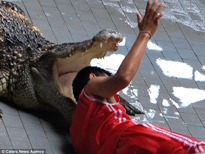 Wrestler li tħobb tipperikola ħajjitha ma’ kull ġurnata li tgħaddi, billi ddaħħal rasha f’ħalq kukkudrill għal €4.92, qed tiġbed folol kbar ta’ nies f’zoo Tajlandiż. Il-ħarrieġ tagħha fil-Pattaya Crocodile Farm iwettaq l-istess att f’ħalq kukkudrill ieħor, maġenbha.
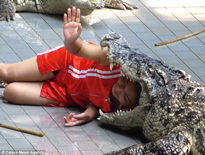 Ian Maclean, li ġibed il-filmat waqt żjara staqsa: “Fadal nies li lesti jipperikolaw ħajjithom f’dan ix-xogħol għal €4.92 kuljum?” Xi żmien ilu, wieħed minn dawn in-nies spiċċa b’rasu misħuqa fix-xedaq ta’ kukkudrill.
Everybody in the village knew Pawlu. Not because he held any esteemed position in the community, nor because he ever did anything exceptional to be remembered for, nor because he liked to mingle freely among the different folk of the village. However Pawlu was the church warden. It was always he who at every mass, be it on weekdays or on Sundays, with collection box in hand, went around the congregation collecting money for the church. And it was often he who led the faithful to recite the rosary before the first evening mass.
Pawlu was 51 years old, still as light and agile as a cat, a good soul and a loving family man. But he had one obsession which only his wife knew about. He was a gambler. Not a heavy one mind you, but a gambler all the same. A man of very modest means, he always thought that one day he would be rich.
All throughout his adult life, every week without fail, he staked a few euros either on a ‘lotto’ or a ‘super five’ or a ‘lottery’ ticket. With his optimistic nature he always expected that he would win, always thought that, this time, his numbers would come out of the large rotating urn holding all the issued tickets. But they never did and he never won.
His wife Marie had a different character altogether. She was mild-mannered, of a calm nature and satisfied with her position in life. Unlike her husband, she did not crave for more money and the modest wage Pawlu brought home each week was enough to make her life comfortable and enjoyable.
Marie repeatedly admonished Pawlu for throwing away money over his weekly stakes. “A gambler”, she used to tell him, “is always a loser, never a winner!” If he had saved the money he had paid for the stake tickets he had bought these last thirty years, she always told him, they would have had a good sum of money in the bank, not nothing.
But Pawlu was certain that one day his numbers, which he never changed, would make him rich. “You’ll see Marie, you’ll see. When I win the one million euros, I’ll buy you a nice house in the new part of the village. And we’ll go for a long holiday. You’ll be so happy that I persisted in playing these blessed numbers”, he told her.
He continued with his mission in life, week in week out, always the same numbers, all signifying some dates or ages close to his heart. He did not trust his short-sighted wife to get him the tickets, being afraid that she would mess up his numbers. “Some day I‘ll become rich” he would often say to himself. And while in church, he would pray to his favourite saints to intercede on his behalf so that his wish would be granted. For thirty years he kept faith. “One day,” he always thought, “one day my luck will turn.”
He would buy his weekly tickets, kiss them tenderly, put them in the jar on the top of the kitchen side-board and wait for the draw on the Wednesday. It was a ritual. Sometimes, out of the same five numbers on which he put his stakes, he would get one number right, or two, or on rare occasions, three numbers. But no wins.
One evening Marie was following the draw on television. The numbers were being extracted from the rotating urn. One, two, three, four, five numbers! Pawlu’s numbers! She could not believe it. She opened the jar, took out the tickets and WOW, they had won it, over one million euros. She just could not believe it!
Pawlu was still at the church, assisting the parish priest at evening mass, after which he made preparations for the morrow’s early mass. Then he bid good bye to the parish priest and left for home. As soon as he entered the house Marie, tears in her eyes, shouted at him –“Pawlu, you’ve won, your five numbers have been drawn, and we’re rich Pawlu, rich!!”
Pawlu stood motionless, at first not realizing what Marie was telling him. Then, still not sure, he told her. “Is it true Marie, this is no joke is it? How do you know?” “I am sure Pawlu. I just heard and saw the numbers on television. I checked with your ticket. Here see for yourself. They’re your five numbers!” she answered breathlessly.
The impact of this news then struck Pawlu. His thirty-year long cherished dream of becoming rich had finally come true. He was now the happiest man on earth. As this realization sunk in, his face became as white as a sheet; sweat seeped down from his face and a stabbing pain run across his chest.
As he clutched his chest with both his hands, he fell on the floor right in front of Marie. She uttered a scream and ran out for help. When the doctor came and examined him, he pronounced him dead. After Marie recounted the events as they had happened, the doctor certified that death was caused by a heart attack, probably following strong, emotional joy on hearing the news of his substantial win.
But the story did not end there. It had another twist. After the funeral, Marie went to the Lotto Receiver with Pawlu’s ticket. He checked the numbers, looked at Marie and told her – “You have a winning ticket with four numbers, not five. The prize is 200 euros!” In her excitement Marie had made a mistake of the last number.
Pawlu, poor soul, had died in vain after all!
Charles B. Spiteri
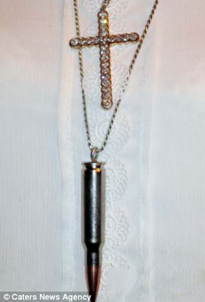
F’pajjiżi fejn il-kremazzjoni (il-ħruq tal-katavri flok dfin) hu komuni ferm, issa qed jingħata tifsira ġdida għall-familjari tal-mejjet.
Idea li żgur tingħoġob minn dawk li jħobbu l-armi tan-nar, hi dik ta’ kumpanija Amerikana li qed toffri li tissiġilla l-irmied tal-familjari f’bullets.
Il-kumpanija Holy Smoke (Duħħan Qaddis) tinsab f’Alabama u hi mmexxija minn Clem Parnell u Thad Holmes. Meta huma jippriservaw l-irmied fil-bullets, jagħtuhom lill-klijenti f’kaxxa speċjali ta’ preżentazzjoni. Iżda għal min ikun irid, huma jħalltu l-irmied ma’ splussiv u jwasslu lill-klijent fi vjaġġ, fejn ikun jista’ jispara xi wħud mill-bullets.
Il-ħlas hu ta’ €798 għal 100 bullet tar-rifle jew 150 bullet tal-pistola u €72.50 għall-kaxxa tal-preżentazzjoni magħmula mill-injam. Persuna medja tipproduċi bejn ħames u sitt libbri ta’ rmied wara l-kremazzjoni u Holy Smoke tuża biss libbra ta’ rmied biex twettaq ħidmietha.
Is-sidien tan-negozju jgħidu li jirċievu bejn erba’ u ħames ordnijiet fix-xahar mill-Istati Uniti, iżda hemm nies oħra li qed jidhru interessati, fosthom mill-Ġappun, l-Awstralja, ir-Repubblika Ċeka u mill-Gran Britannja.
Huma jsostnu wkoll li jekk il-fdal ta’ persuna jimtlew f’bullets mal-porvli, joffru assigurazzjoni lill-familjari f’każ li jidħol xi ħadd fuqhom biex jisraqhom, u b’hekk tibqa’ rabta sħiħa bejn il-mejjet jew mejta u niesu ħajjin. Hemm min jippreferi li bullet minnhom tkun pendent biex tinġarr kuljum fuq il-persuna li tibqa’ ħajja.
MISRAĦ (pl. msieraħ) Ġan Franġisk Abela (1647) jiddeskrivi l-misraħ bħala l-pjazza tar-raħal qrib il-knisja, fejn in-nies kienu jinġabru fil-jum tal-Ħadd jew f’xi festa pubblika biex iqattgħu l-ħin jitħaddtu flimkien. Fil-ktieb Place-names ta’ Godfrey Wettinger insibu aktar minn erbgħin post li fih hemm inkluż dan l-appellattiv. Biss, dawn x’aktarx kienu nħawi fejn jirgħaw il-mogħoż. Fost dawn insibu Misraħ il-Kbir, Misraħ il-Mitħna, Misraħ il-Wardija u l-Imsieraħ, li llum ħafna minnu nbena u sar il-lokalità ta’ San Ġwann.
Charles B. Spiteri

Il-kumpanija Google dan l-aħħar ħabbret li se tibni karozza li tinstaq weħidha – u l-pjani huma li fi żmien sena ssir rivoluzzjoni sħiha fil-vetturi fit-triq.
Sergey Brin, ko-fundatur kixef din il-karozza, li se tkun mgħammra biss b’buttuna ta’ ‘suq’ u ‘ieqaf’ u tkun kapaċi ttella’ ħeffa sa 25 mil fis-siegħa.
Flok ma ħadmet fuq karozza li diġa’ tinsab fis-suq, il-kumpanija ġganteska bniet il-mudell tagħha u qed taħdem fuq madwar 100 prototip biex saritilhom il-prova. Il-ħsieb wara dawn il-karozzi hu li jneħħu l-uġigħ ta’ ras minn fuq is-sewwieqa.
Id-disinn tal-karozza hu ta’ wiċċ ħabib, biex in-nies ma taqtax qalbha u taċċetta din it-teknoloġija ġdida.
Ingħad li dawn il-karozzi se jnaqqsu bosta problemi, fosthom li waqt il-ħin tal-kolazzjon, il-ħaddiema jistgħu jmorru jduru mingħajr il-ħsieb li jsibu fejn jipparkjaw. L-anzjani jistgħu jmorru fejn iridu bla ma jġorru ċwievet, u l-aqwa fosthom hu għal dawk is-sewwieqa li jkunu xorbu xi grokk żejjed u ma jixtiqux isuqu lura.
Dawn il-karozzi ma għandhomx, la steering, la pedala tal-gass u lanqas tal-brejk… għax m’għandhomx bżonnhom. Chris Urmsom, direttur tal-proġett qal li s-software u s-sensors se jagħmlu x-xogħol kollu huma. Li hemm fil-karozzi huma biss il-buttuna ta’ ‘suq’ u ‘ieqaf’ u screen li juri r-rotta.
Urmon qal li l-karozzi se jirrivoluzzjonaw is-sewqan, b’mod li s-sigurta’ tingħata prijorita’.
 NASPLA Il-qawl ‘In-naspla saret u ċ-ċawla taret’ hu spjegat fil-ktieb ‘Ara X’Int Tgħid’. Ma’ dak spjegat xtaqt nagħti biss xi informazzjoni oħra li għaddihieli Anton F. Attard. Dan il qawl hu x’aktarx mibdul mit-taqbila oriġinali. Il-qawl suppost jgħid hekk: Il-lira sfaret u ċ-ċawla taret. It-taqbila nħolqot meta fi tmiem tas-seklu dsatax kien falla l-Bank ta’ Rosa Pace, li kien imlaqqam ‘il-Bank taċ-Ċawla’. Dan il-Bank kien jinsab fi Strada San Franġisk, il-Furjana. Anki t-triq fejn kien hemm dan il-Bank spiċċat imlaqqma ‘It-Triq taċ-Ċawla’. Meta Rosa Pace bdiet tissellef il-flus tad-deheb bi mgħax għoli, falliet. Ir-riferenza għall-flus li sfaru hi għal-liri tad-deheb. Meta falla l-Bank, lil Pace tellgħuha l-Qorti iżda ħarġet illiberata u għamlet festa. Ħajr: Anton F. Attard.
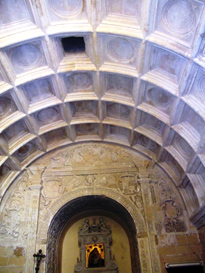
PANEW (f’sens ta’ arkitettura) (pl. panewijiet) Wieħed jista’ jirreferi b’dan in-nom għal xi tip ta’ dekorazzjoni fil-ġebel, ħafna drabi maħduma fis-saqaf ġo xi bini antik ta’ ċerta importanza. F’Malta hawn ħafna binjiet fejn is-saqaf hu ddekorat f’dan l-istil. Forsi l-aktar li jispikkaw huma dawk ta’ xi knejjes, inkella s-soqfa f’xi bereġ tal-Ordni. Jidher li dan l-istil dekorattiv kien beda jkun applikat f’Malta mit-tieni nofs tas-seklu sittax. Naraw dan ix-xogħol f’bosta binjiet, pereżempju fl-entratura oriġinali tal-Berġa tal-Italja, fi Triq il-Merkanti, il-Belt, kif ukoll fil-binja tal-Berġa ta’ Franza, fil-Birgu. II-kelma x’aktarx ittieħdet minn PANNELL, li tfisser ‘drapp li jitqiegħed taħt is-sarġ fuq dahar iż-żiemel’. Bl-Ingliż coffering.